

The Rich Communication Services (RCS) channel is available as a paid add-on. Contact your MoEngage Customer Success Manager (CSM) or the Support team to enquire and enable it for your account.
- On the sidebar menu in MoEngage, hover over the Engage menu item
 . The Engage menu appears.
 - Click + New Campaign. You can also click All Campaigns on the Engage menu and then click + Create campaign on the All campaigns page.
- On the New Campaign dialog box, under Outbound, click RCS.

- Select one of the following campaign delivery types:
- One Time
- Periodic
- Event Triggered
- Business Event Triggered
For more information on delivery types, refer to Delivery Types.

Steps to Create an RCS Campaign
The following are the steps to create an RCS campaign:- Target users: Define the target audience for the campaign.
- Content: Define the content of the RCS campaign to be sent.
- Schedule and goals: Define the campaign’s delivery schedule and goals.
Step 1: Target Users
This section contains the following:Campaign Details
The campaign details section contains the following fields:Select Audience
This section contains segmentation filters that help you choose the target audience for your campaign. The following options are available:- All Users
- Filter by User Property
- Filter by User Behavior
- Filter by User Affinity
- Filter by Custom Segment
This filter option allows you to send the campaign to all the app users. When you use this option, you cannot add multiple filters.


This is an add-on feature. Please contact your MoEngage CSM (customer success manager) or the Support team to enable it for your account.
- Create Multiple Filters: You can create and combine multiple user property rules, user activity rules, and custom segment rules to create a complex user segment using this option.
- Click + Filter.
- Click AND or OR.
- Select the attribute or event and define the filter conditions.
- Exclude Users: Select this checkbox to define the filter criteria for users to be excluded from the campaign.
- Send campaign to the users opted-out in subscription management: Turn this toggle on to automatically include opted-out users from the campaigns. For more information, refer to Subscription Management.
- Reset filters: Click this option to reset the segmentation filters.
- Show count: Click this button to display the total number of users who are currently in the configured segment.

Control Groups
This section contains information about control groups for the campaign. A control group is a set of users added to an exclusion list. These users will not receive the marketing campaign. Control Groups are enabled only for promotional campaigns and are not applicable to transactional campaigns. You can enable the control groups to which you want to send the promotional campaign. In the Enable control groups section:- A global control group is a list of users who will not receive any of the marketing campaigns. Turn the Global control group toggle on to not send the campaign to all the users in the control group.
- Campaign Control Group is created by combining the user base that qualifies for the campaign. Turn the Campaign control group toggle on to not send the particular campaign to the control group. For more information, refer to Control Group.

Step 2: Content
This section describes how to create content for your RCS campaign. Perform the following steps to create content for the RCS campaign:
- In the Select sender list, select the RCS sender (service provider). Note that the sender selected here must support SMS as a fallback if you want to send a fallback SMS. If fallback SMS is not supported by this sender, the Use SMS as Fallback checkbox is disabled.
- In the Select templates list, search or select one of the templates. For more information, refer to RCS Templates.
- Customize the content as defined in the template.
- To personalize your message, enter @ in the field. The RCS Personalization pop-up window is displayed. For more information, refer to Personalize RCS Campaigns.

- Select the Use SMS as Fallback checkbox to ensure message delivery. MoEngage first attempts to send the message as an RCS message, and if the recipient’s device or network does not support it, the message is automatically delivered via SMS. Enter the following details for your fallback SMS.

- In the SMS sender list, select a sender. Note that the SMS sender selected here must be the same as the RCS sender selected in the Configure RCS Message section.
For example, you have configured Sender A and Sender B as RCS and SMS senders. If you choose Sender A as an RCS sender in the Configure RCS Message section, make sure you select Sender A as the SMS sender in the SMSsection. - In the Template ID field, type the ID of your template. Note that the Template ID is a mandatory field as per India’s DLT regulations. You can check with your provider to see if you need to pass it.
- In the Message field, type the content to be displayed in the SMS.
- If you selected the default template, add the message to be displayed in the fallback SMS.
- If you selected a custom template for fallback SMS, the template will be loaded into the UI with all the field details. For more information, refer to Create Content using Custom Templates.
- You can change the template by clicking Template actions.
- In the SMS sender list, select a sender. Note that the SMS sender selected here must be the same as the RCS sender selected in the Configure RCS Message section.
Personalized Preview
Personalized preview allows you to visualize how your personalized content appears to end users. You can preview the message types with personalized content on the right side of the screen. Perform the following steps to preview the personalized content:- Click the respective tabs for the message type to preview the personalized content.
- Select the Preview type as Default or Personalized.
- Click the edit icon adjacent to the Personalized Preview type. You are taken to the Personalized preview page.
For more information, refer to Personalized preview.
URL Addition and Shortening
Add the URL in the RCS message to track RCS clicks for the URL. MoEngage will use URL shortening services to shorten your URL and then track the users who click the URL. Note that URLs included in the RCS actions, when clicked, are tracked by default and don’t need shortening. The following points are to be noted for URL Shortening:- Shortened Links expire in fourteen days and cannot be tracked after expiry. When a customer opens a link beyond its expiry, they see a “This link is no longer active” message.
- If user and event attributes are used in the shortened links, the attributes’ names must abide by the following:
- They must not contain spaces.
- If the attributes contain links, their values should not contain http:// or https://. These can be added before the attribute to shorten the link.
- Special characters such as apostrophes and commas are not supported in shortened links.
- Multiple JINJA operations are not supported in links that are to be shortened. For example, using a Content API link in a Product or vice versa (in a link that is to be shortened) is not supported.
Add a Locale
Locale is a criterion based on which you can further sub-segment your target audience to send them a Localized message. To add a locale to the campaign, click + Locale at the top right corner of the content creation step. You can add a new locale or add an existing locale to the campaign. For more information, refer to Localize campaign message.Add a Variation
Creating variations of campaigns allows you to determine the effect of a modified variable on other campaign variables. It also enables the comparison of performance between campaign variations.To add a variation to the campaign, click + A/B test at the top right corner of the content creation step. You can add a new variation or copy the existing variation. After adding a variation, you can see the variations as tabs on the top ribbon above the content editor, as shown below. You can specify the user distribution for each variation by clicking User Distribution, which is available at the top right corner. For more information, refer to A/B Testing.
Test Campaign (optional)
Test Campaign (optional)
Test campaigns enable previewing the campaign on a test device to ensure that your notification is conveyed in the manner that you desire.You can test the campaign you created by selecting any of the following options and providing the value for the attribute chosen for your test user:
- Unique ID
- Email ID
- Mobile Number (Registered With MoEngage)
- Mobile Number (External/Not Registered with MoEngage)
- Google Advertising identifier
- iOS Identifier for Advertising
- Device Push Token
-
Custom Segment

Step 3: Schedule and Goals
This section contains the following:- Delivery schedule: Choose when the campaign should be delivered to your users and the periodicity of delivery.
- Conversion goals: Choose the conversion goals and revenue metrics to be tracked for the campaign.
- Delivery controls: Choose the advanced delivery control options such as throttling, frequency capping, and expiration settings for the notification. For more information about minimum delay between campaigns, refer here.
Delivery Schedule
One Time
One Time
- As soon as possible
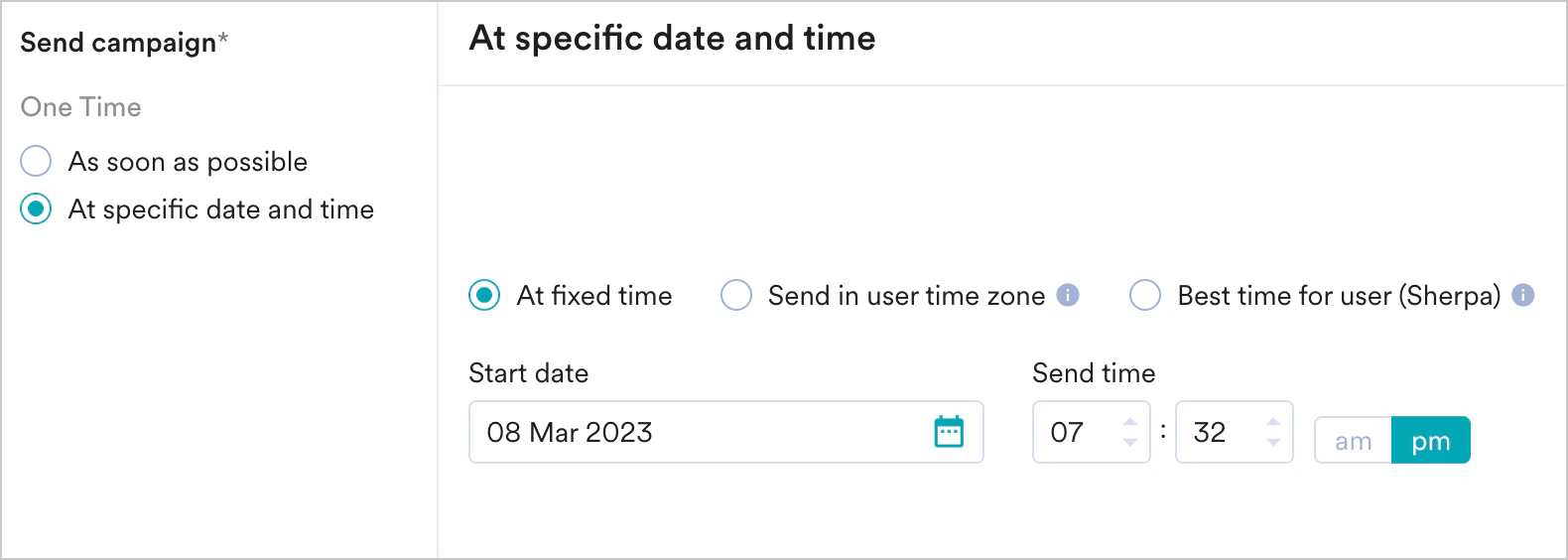
- At specific date and time
Send the campaign immediately to the target users.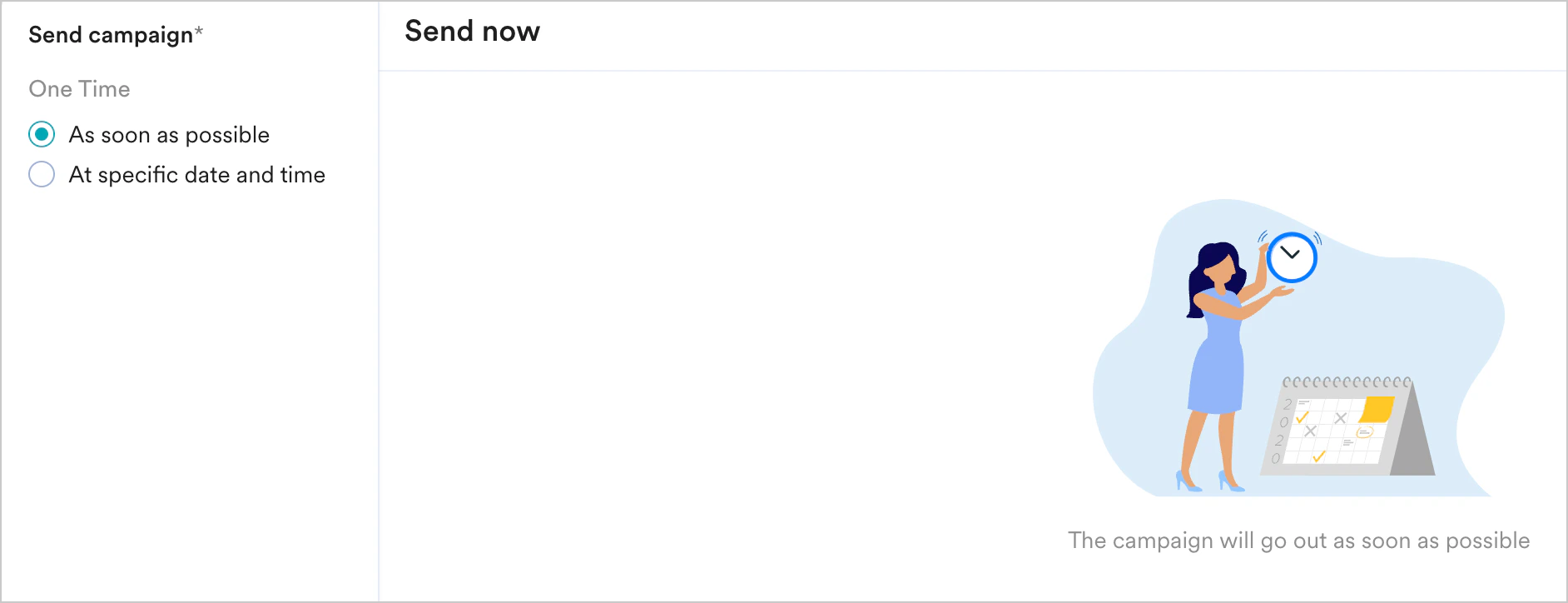
Periodic
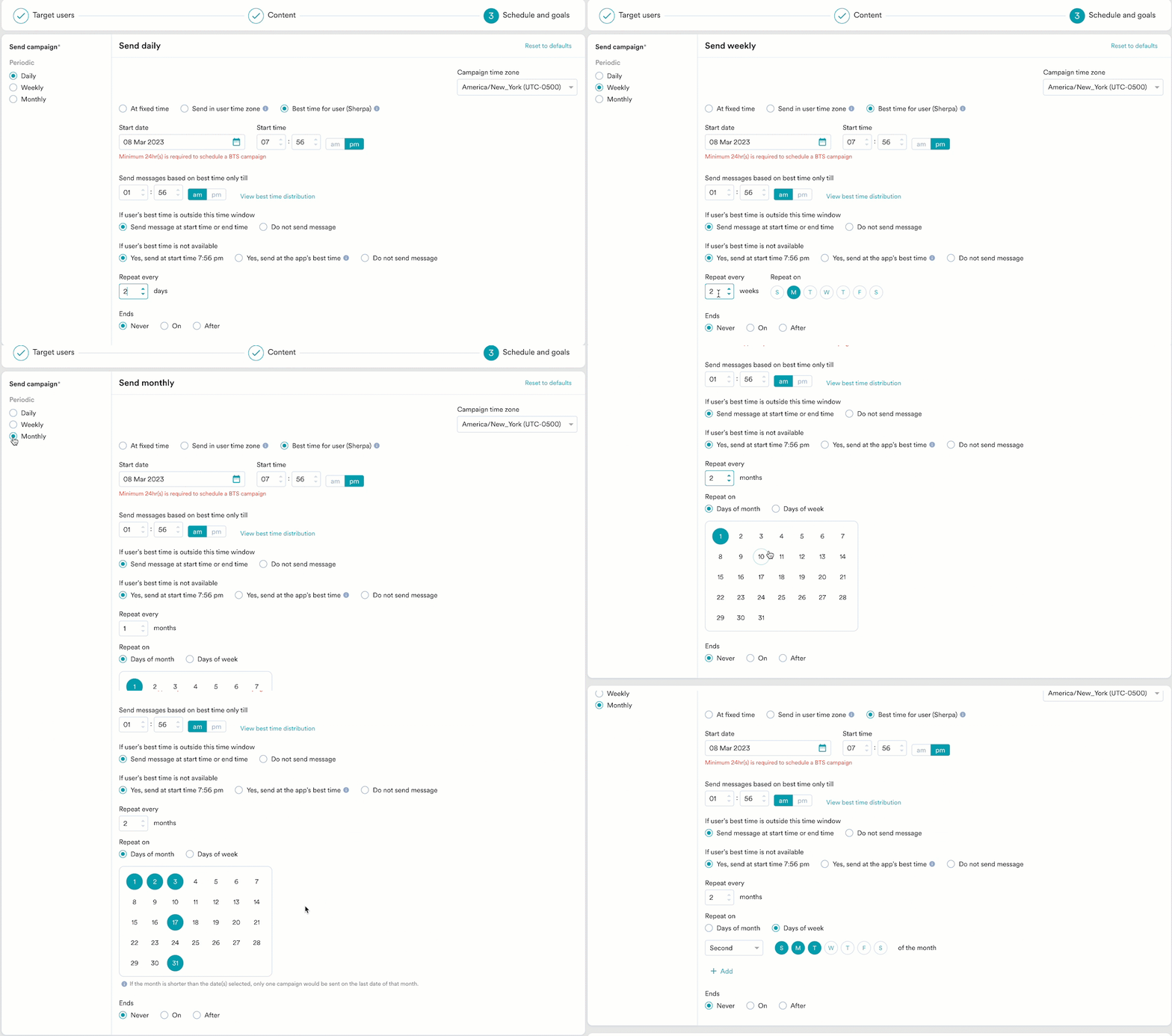
Periodic
- At fixed time
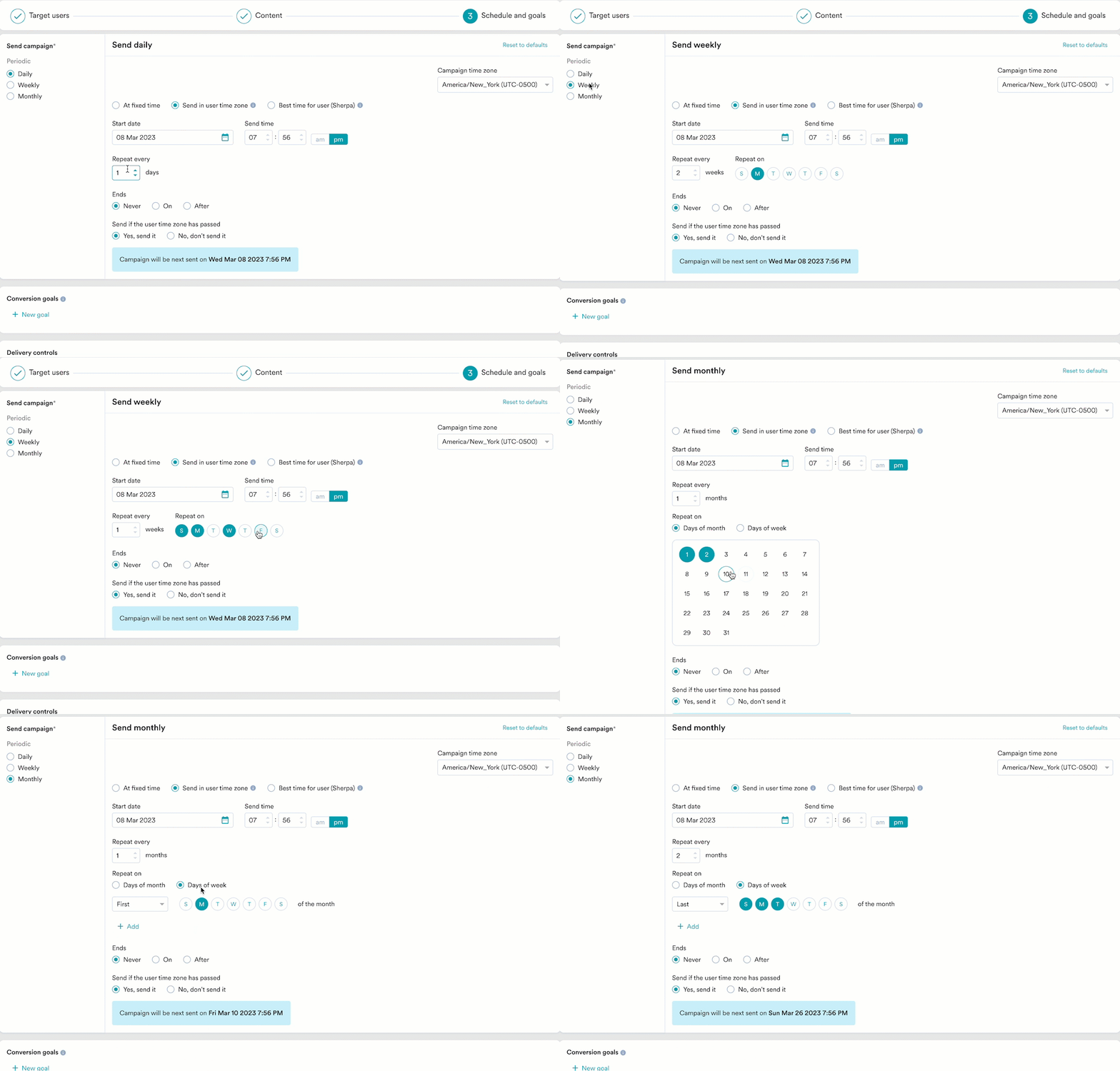
- Send in user time zone
- Best time for user (Merlin AI)
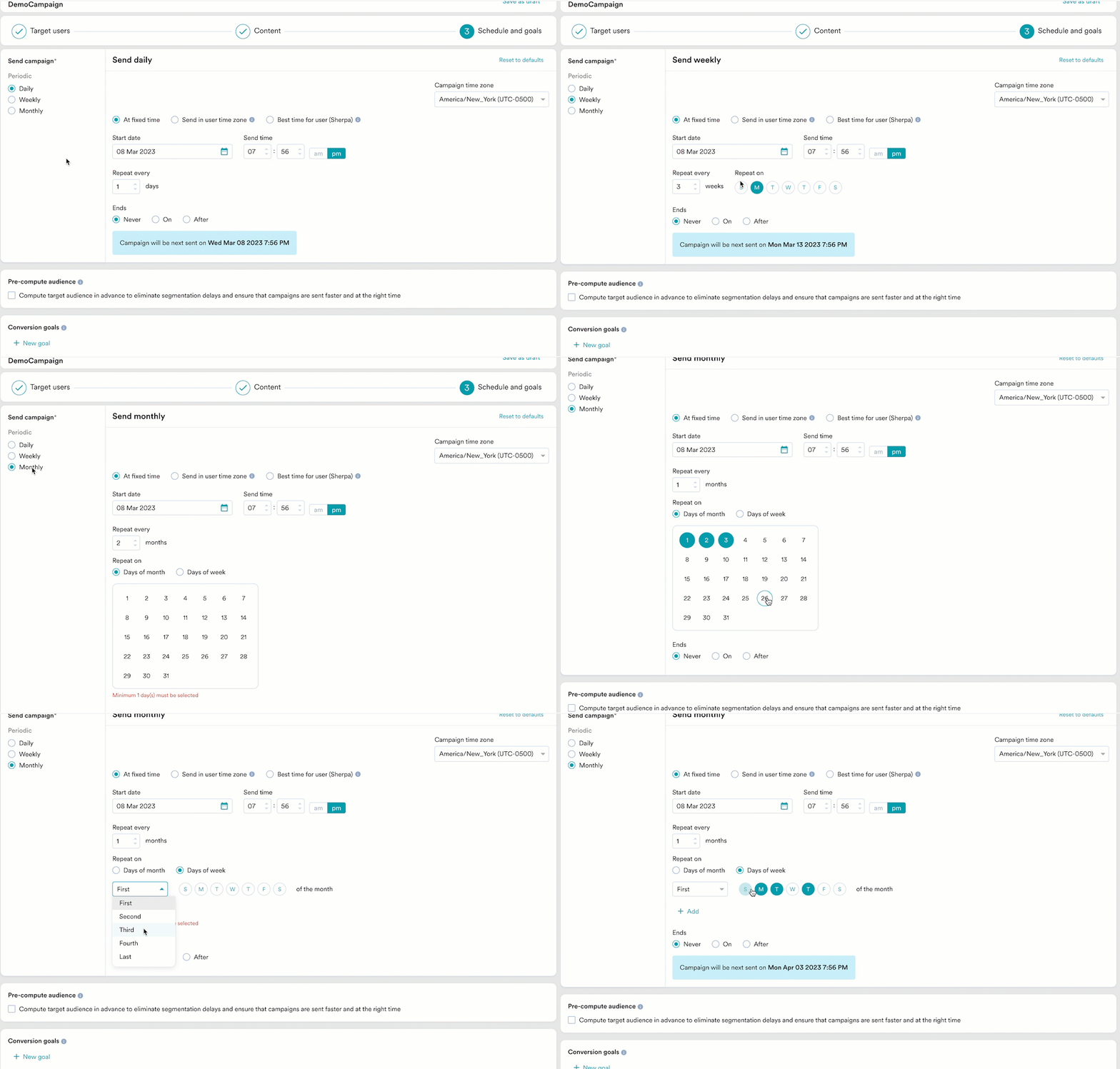
Choose this option to send the campaign on a specified date and time. The following fields are available in this section:
- Campaign time zone: The timezone in which the campaign should be sent.
- Start date: The date on which the campaign should be sent.
- Send time: The time at which the campaign should be sent. Select am or pm depending on the time of day.
-
Periodic: The periodicity of the campaign. You have the following options: Daily, Weekly, and Monthly.
-
Ends: The date on which the campaign ends. The following options are available:
- Never: The campaign is scheduled to run daily.
- On: The campaign ends on the date specified in the End Date field.
- After: The campaign ends after the number of occurrences specified in the occurrences field.
Event Triggered
Event Triggered
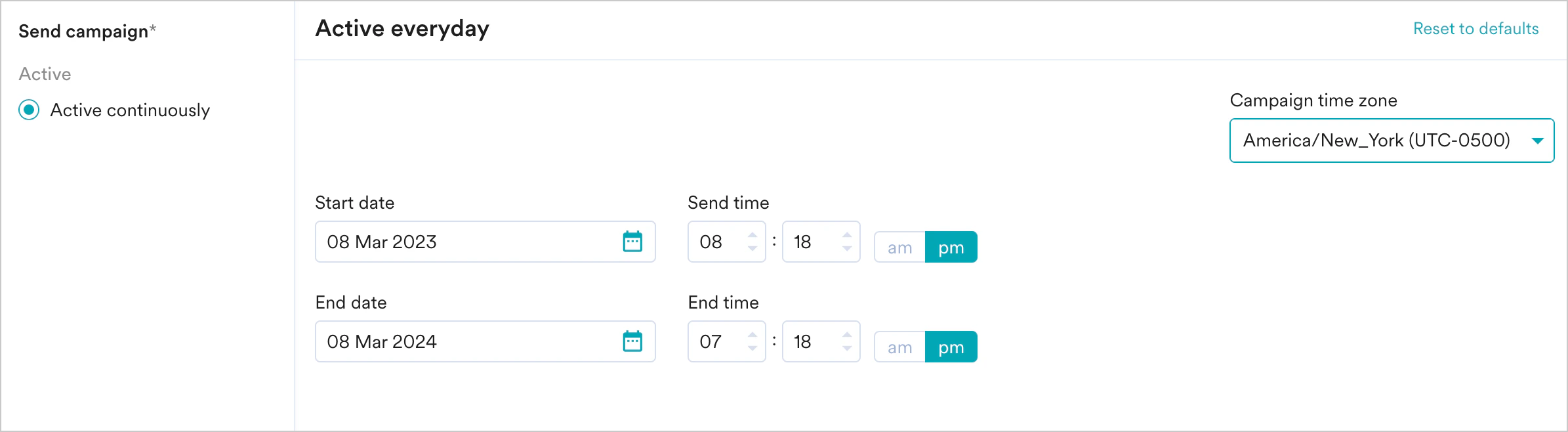
Click Active continuously under Send campaign and do the following:
When will event triggered campaigns be sent?The campaign will be sent only when:
- The event property/attribute being used to create these types of triggers (like the flight_time example) is in a valid date-time format. If it is not in a date-time format, the string should have data in one of the supported formats. If the selected attributes do not contain data in any of these formats, the campaign won’t be sent to your users.
- The date/time value from the attribute is greater than the time at which the trigger condition is fulfilled.
- The date/time value from the attribute is less than 30 Days + the time at which the trigger condition is fulfilled. For example, if your trigger condition is fulfilled at date D, your notification will be sent only when the attribute value is less than D+30.
-
The intelligent delay optimization (With Delay) does not work for campaigns sent on relative timing.
Business Event Triggered
Business Event Triggered
Click Active continuously under Send campaign and do the following:
When will business event-triggered campaigns be sent?The campaign will be sent only when:
- The data type(s) of the user attribute(s) or event attribute(s) mapped to the data type(s) of the business event’s attribute(s) match.
- The attribute(s) used in segmentation are passed in the trigger request for the business event.
-
The intelligent delay optimization (With Delay) does not work for campaigns sent on relative timing.
Conversion Goals
You can add conversion goals to track the business metrics for your campaigns. You can track a maximum of five conversion goals. You can choose any app event as a conversion goal activity and set more than one conversion goal. The first goal will be treated as a primary goal. For example, if you want to track the number of customers who have purchased an iPhone after your campaign was sent. (Event: Purchase event, Product: iPhone). Your conversion goal setup might be similar to the following image:
- How many users have viewed the product page?
- How many of them added that product to the cart?
- How many of them made a successful order?
Tracking Revenue Performance (Optional)
Tracking Revenue Performance (Optional)
| With MoEngage, you can track the revenue generated by your campaigns. For example, you can track the revenue generated by your product after sending a communication. To track revenue performance, enable the Revenue performance toggle for the conversion goal for which you want to track the revenue. In the example here, to track revenue for orderSuccessful events, you must enable the Revenue performance toggle. |  |
| After choosing the goal, you can select the numeric attribute that captures the order’s total monetary value. In this example, cartValue contains the total order value. You can choose the currency in which your monetary value is being reported. |  |
| Set Attribution window: You can set an attribution window (a time period or window that is calculated since the user has received/clicked the campaign, for which you want to attribute the conversion goals to a specific campaign.) By default, it is set for 36 hours while the maximum attribution window can be set up to 10 days. In the example below, the attribution window is set to 36 hours. |  |
Delivery Controls
- Delivery Control for One Time, Periodic, and Business Event Triggered Campaigns
- Delivery Control for Event Triggered Campaigns
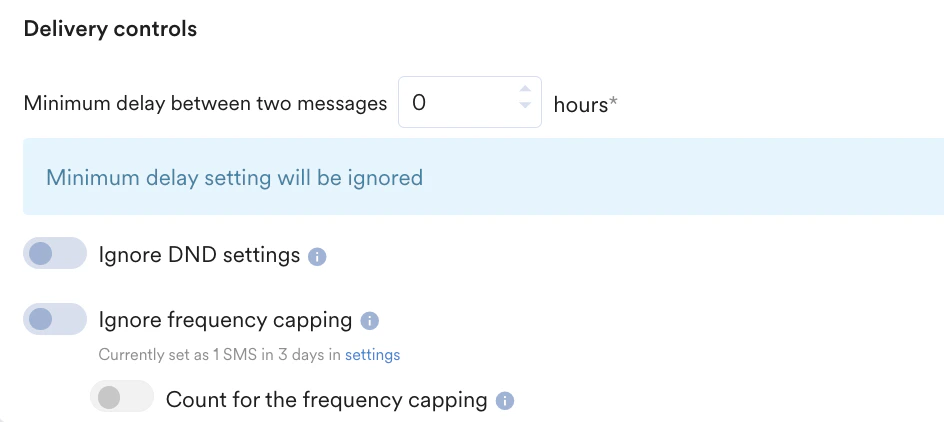
This section contains the following options:Frequency CappingThis feature helps control the number of RCS messages sent to a user in a day.
- Ignore frequency capping: Enable this toggle to ignore the frequency capping limit for this RCS campaign. Click Ignore frequency capping to ignore the capping for your RCS campaigns when you want to ignore the capping but want this campaign to be counted. For example, the frequency capping value is set to three. You have sent three campaigns today to a group of users. You realize that the RCS messages triggered by this campaign is urgent and should go on high priority even though some customers have already received three campaigns. If you use the Ignore Frequency Cap, people who have already received 3 campaigns will receive this one as well. For more information, refer to Frequency Capping.
- Count for the frequency capping: Enable this toggle if you want this connector to be counted for frequency capping limit. If you use Count for frequency capping, people who would have received 2 communications already and send this as well, their receipt count will become 3 after this campaign is sent. Throttling Throttling is a feature that allows you to control the sending rate of RCS campaigns. In the Request limit section, enter the number of requests per minute sent for the RCS campaigns. For example, send the request URL with a default of 60,000 rpm (minimum of 60,000 requests per minute and maximum of 200,000 requests per minute). For more information, refer to Throttlling.

Campaign Actions
After publishing the campaign, you can view the campaigns in Engage > Campaigns. Click the ellipsis icon under Actions to view the following campaign actions:- View: This option allows you to view campaign information. Clicking this option takes you to the Campaign analytics and info page.
- Duplicate: This option allows you to create a copy of the campaign with all existing details, appending Duplicate to the campaign name.
- Edit: This option allows you to edit campaign details.
- Pause: This option allows you to pause a campaign.
- Archive: This option allows you to archive a campaign. The archived campaigns can be unarchived.
- Unarchive: This option allows you to unarchive a campaign.


- Campaign Status: A campaign can have various statuses, including Active, Expired, Not Sent, Paused, Scheduled, Sending, Sent, and Stopped. If the Campaign Approval Workflow (CAF) is enabled, additional statuses such as Under Review and Rejected are also available.